
Relationship-driven marketing helps law firms stay connected through relevant email, segmentation, and client communication.

Your law firm’s client development isn’t limited to when someone is sitting across the table. Even when clients don’t have an immediate legal need, it’s trust, familiarity, and visibility that influence which firm they call the next time they need legal support. Here’s how relationship-driven email can help law firms support those connections more deliberately.
For law firms, growth often comes from existing relationships, whether that means new matters from current clients or referrals from people who already know and trust the firm. However, those connections don’t stay active on their own. Matters close, immediate legal needs pass, and attention shifts elsewhere. Without ongoing communication, that contact can drift, especially when other firms are competing for the same attention. By contrast, a client who continues hearing from the firm in relevant ways is more likely to return with new matters, turn to the firm for work in another practice area, or refer someone else who needs legal support.
Relationship-driven marketing gives firms a way to stay present between matters through communication that is timely, relevant, and informed by the rapport the firm has already built with the contact. As a result, firms are better positioned to stay connected to current clients, keep prospects warm, nurture referral sources, and continue building trust with alumni and other professional contacts.
A current client, a prospect, and a referral source shouldn’t all hear from the firm in the same way. Each group calls for different communication, from the topics you cover to the email templates you use. A more tailored approach to email gives firms a practical way to reflect those differences across their audiences, so communication stays aligned to the people receiving it.
Email marketing for law firms requires a detailed picture of who the firm is communicating with and why. Without that, firms are guessing at how to group contacts into segments, and personalization is limited to basic fields like first name rather than specific details tied to a contact’s interests or connection with the firm.
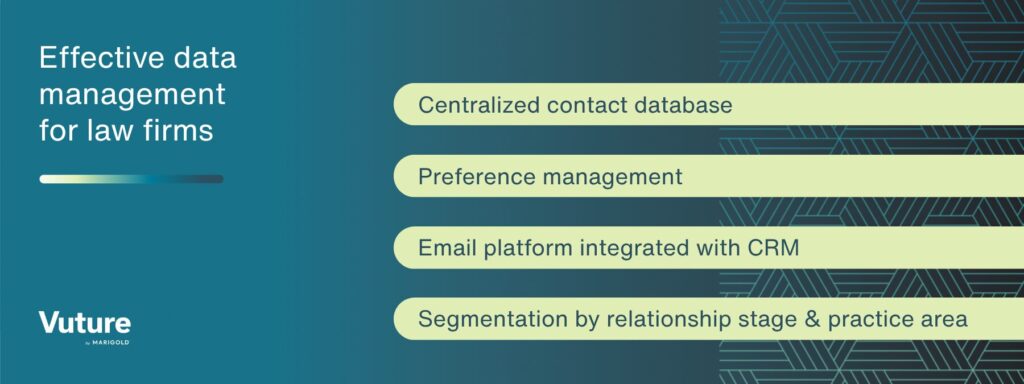
Law firm contact lists are often fragmented. Data spans current clients, past clients, prospects, referral sources, and alumni, and it may be spread across partner inboxes, a CRM, and one or more marketing tools. Having a reliable central record—and an email platform that connects to your CRM—is essential for law firm email marketing.
An existing client shouldn’t receive the same sequence as a cold prospect or someone in your alumni network. Your contact data should signal where each contact stands with the firm, which should then determine the message you send. Segmentation by practice area, contact type, and communication preference allows firms to send more relevant communications instead of the same update to everyone.
Firms often run into a similar set of problems:
Email marketing for law firms serves a specific purpose: keeping the firm top of mind in a way that feels relevant between active matters. The goal is consistent, relevant communication over time.
The types of emails that work best in this context are those tied directly to the recipient’s history with the firm. Thought leadership and legal updates targeted by practice area give clients a reason to open and read. Event invitations, when sent from a partner rather than a generic firm address, feel more personal than a mass send. Post-event follow-up, anniversary touchpoints, and practice area digests all help keep the connection active between matters.
These emails feel relevant when the audience is clearly segmented and the content reflects what the recipient cares about. If someone has only ever engaged with employment law content, they shouldn’t start getting corporate governance updates.
For a small marketing team managing communications across multiple practice areas and partner preferences, automation helps sustain that level of consistency. With Vuture, follow-up sequences, re-engagement emails for contacts who have gone quiet, and triggered sends based on event attendance can all run without manual intervention, freeing the team to focus on content and strategy rather than logistics.
In person, lawyers naturally adjust how they communicate based on who they are speaking with, what the client is there for, and the client’s history with the firm. Segmentation helps firms bring that same level of attentiveness to email. It gives digital communication more of the relevance and context that already shape strong client ties offline.
A law firm’s contact list includes more than current clients. It may also include prospects, referral sources, alumni, and other professional contacts. Each of those groups has a different history with the firm, which means they shouldn’t all receive the same messages in the same cadence.
Current clients need communication that helps the firm stay relevant between matters. That may include legal updates tied to the practice areas they rely on, invitations aligned with their interests, or thought leadership connected to the sector they work in. The goal is to keep the client engaged, even when there is no immediate matter to discuss.
Prospects require a different approach. Their ties to the firm are less established, so emails should focus on demonstrating expertise in the areas most relevant to their work. Practice-area insights, timely commentary, and content related to the issues they’re likely dealing with can help keep the firm visible until a need arises.
Referral sources also warrant their own segment. The communication they receive should reflect the kind of work they are most likely to refer and the areas where they already know the firm has credibility. A referral source focused on employment issues shouldn’t receive the same content mix as one working primarily in corporate transactions.
Alumni are another distinct audience. They may no longer work at the firm, but they remain part of its broader professional network, and that connection still needs attention. Communication to alumni may focus less on legal updates alone and more on staying connected through firm news, selected thought leadership, and opportunities for continued engagement.
Personalization should extend beyond the name field and reflect the rapport your firm has built with that contact. In practice, that can mean varying the sender, the topics covered, the frequency of communication, and the calls to action based on where the contact stands with the firm. A current client may receive a partner-led note tied to a recent development in their sector, while a prospect may receive a more introductory piece of thought leadership on the same topic.

Open rates and click rates are a starting point, but they don’t tell a law firm whether its marketing is strengthening relationships. Here’s what to look at instead.
Useful tracking and reporting reflects engagement quality rather than volume, and looks at whether communications are becoming more relevant and effective over time, not just whether a single campaign performed well.
Click-through rate is one of the clearest signs that a contact found an email relevant enough to engage with. Over time, click patterns can show which topics, formats, and calls to action are holding your audience’s attention and where there’s opportunity for improvement.
Re-engagement rates, or how many previously inactive contacts respond to a targeted sequence, show whether the firm is maintaining connections that might otherwise lose momentum. If a segment that had gone quiet starts engaging again, that signals the firm is sending more relevant communication to that audience.
If one segment is consistently opening and clicking while another is disengaging, that points to a content, audience, or timing issue that can be addressed before contacts unsubscribe or stop engaging altogether.
When a contact requests a consultation, downloads a piece of content, or registers for a webinar after clicking through an email, that is a stronger sign of interest than an open or click alone. Tracking those actions helps firms understand which email content is leading to meaningful next steps.
Attribution is typically imperfect in a law firm context. A matter may originate months after a contact has engaged with a series of emails, and that path is not always captured neatly in reporting. What metrics a firm can track is whether contacts are moving from cold to warm across multiple touchpoints, whether partners are hearing that clients have seen or referenced firm communications, and whether key segments are staying engaged over time. Taken together, those patterns give the firm a clearer view of whether its email program is supporting stronger client loyalty.
A simple reporting cadence is usually more practical than a complex dashboard. A monthly review of engagement by segment gives the marketing team enough information to make decisions without creating reporting overhead that nobody has time to maintain.
Relevant, well-timed content helps law firms strengthen their ties with clients, prospects, referral sources, and alumni. To keep that communication relevant over time, firms need contact data they can trust, audience segments that reflect client history, and a setup that makes personalization and reporting manageable.
For law firms, relationship-driven email is easier to sustain when marketing and client teams can work from the same picture of contact activity. Shared visibility helps firms segment audiences more accurately, tailor communication by practice area, contact type, sector, and stated interests, and keep those audiences current as circumstances change.
Vuture was purpose-built for law firms and designed around the reality that client development is integral to law firm marketing and long-term success in the legal sector. From CRM integration and custom fields to dynamic segments and intelligent reporting, Vuture’s email platform gives firms the structure to build and sustain those audiences through more relevant email.
See how Vuture helps law firms build stronger client relationships →